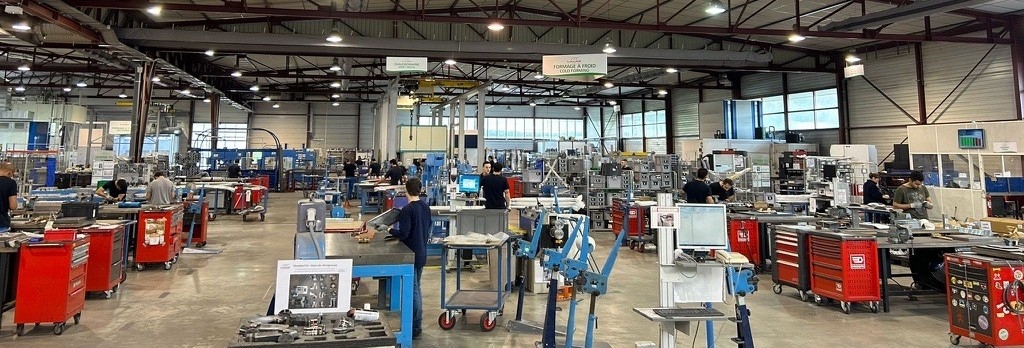
Production order tracking is a key competitiveness factor in demanding industries such as aerospace, defense and high-tech manufacturing.
Small production batches, a wide variety of references and constantly shifting priorities make production flow management particularly complex. Errors in scheduling, time losses and coordination issues can quickly create bottlenecks and impact OTD (On-Time Delivery).
Beyond delivery performance, these disruptions often reveal deeper inefficiencies : poorly synchronized flows, lack of real-time visibility and underutilization of resources. All of these factors directly impact overall industrial performance.
Regaining control over production flows
In an environment where pressure on lead times and productivity continues to increase, manual management of production orders quickly reaches its limits.
Without clear, shared visibility, teams are forced to constantly arbitrate between competing priorities, often without reliable real-time information. Operators lose time locating parts, decisions are made based on incomplete data, and the gap between planned scheduling and actual execution widens.
These imbalances are not trivial. They generate time losses, unnecessary work-in-progress and delays that directly affect customer commitments.
In practice, several factors make production flow management more complex.
Multiplication of references
Producing small batches with a high diversity of parts requires precise identification at every stage. A single delay or prioritization error can disrupt the entire production chain.
Limited shop floor visibility
Without clear on-site guidance, operators spend valuable time searching for the right container or component. This inefficiency leads to increased work-in-progress and deteriorating OTD performance.
Asynchronous flows
Internal logistics and production flows are not always aligned. Parts may be available but not visible, while urgent orders remain unprocessed due to lack of clear identification.
These misalignments generate performance losses that are difficult to detect without reliable field data.
Infrastructure rigidity
Wired systems or solutions requiring fixed infrastructure are costly to deploy and difficult to adapt. In constantly evolving production environments, this rigidity limits the ability to optimize flows.
Ineo‑Sense's answer : TRK‑Tracer® IoT sensor for production order tracking
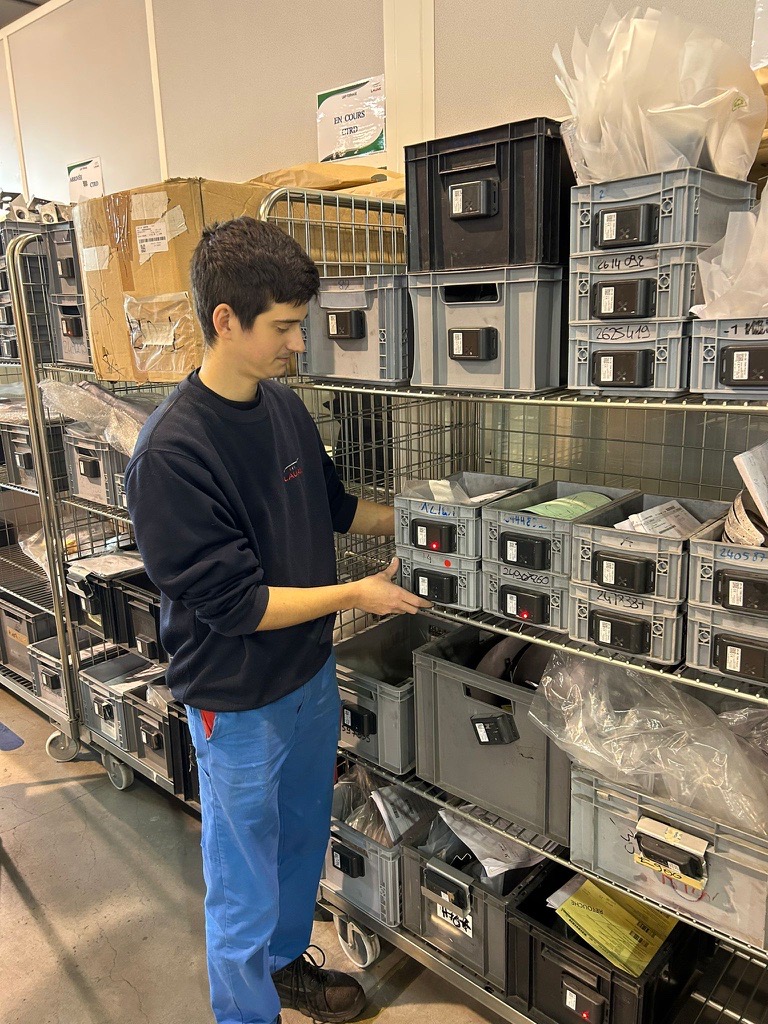
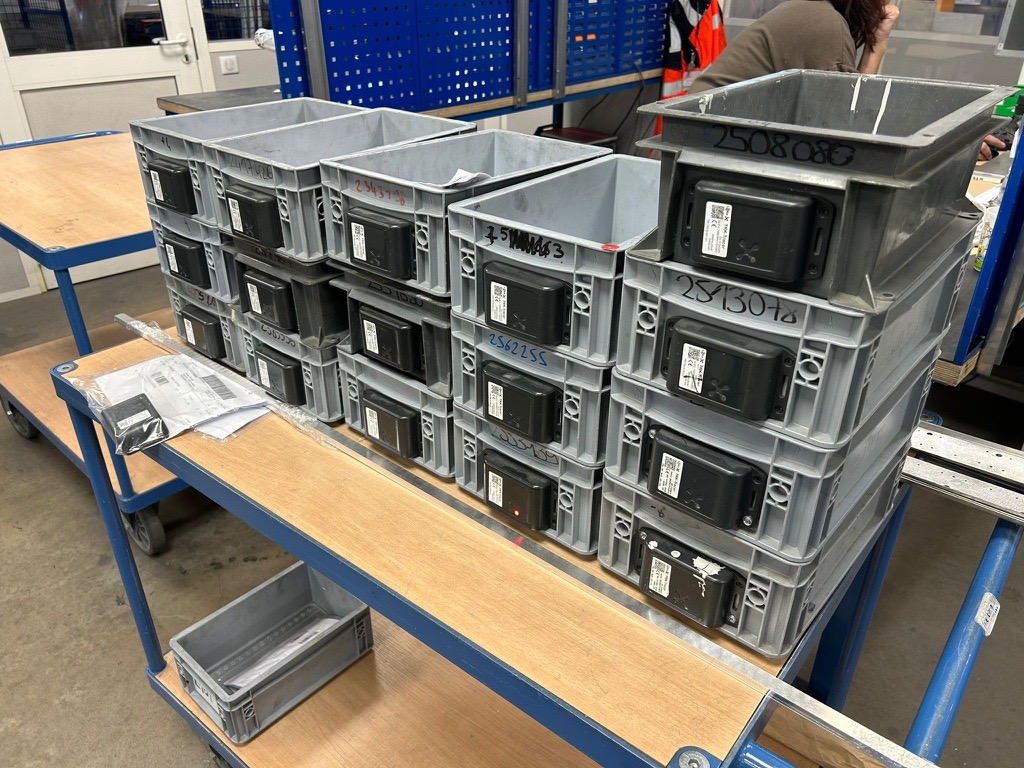
The TRK-Tracer®, a wireless IoT sensor, is attached to each container or critical part and communicates in real time with your ERP/MES via LoRaWAN or our Clover-Net® protocol.
As soon as an order becomes a priority, the integrated LED activates according to a color code, guiding operators directly and unambiguously to the task at hand.
This immediate visibility reduces decision friction, accelerates execution and minimizes errors.
Key features
The TRK-Tracer® IOT sensor is designed to integrate seamlessly into demanding industrial environments while providing real-time visibility on production flows.
Continuous localization enables real-time tracking of each production order across the workshop, without blind spots, thanks to optimized LPWAN coverage.
LED-based visual identification provides instant guidance for operators. Priorities are visible from a distance without the need to consult any interface, significantly improving shop floor efficiency.
Bidirectional communication allows order status updates directly from the tag, eliminating manual input and reducing discrepancies between planned and actual data.
Extended battery life ensures several years of operation without maintenance, even in constrained environments.
Finally, plug-and-play installation enables rapid deployment without production disruption and easy adaptation to workshop changes.
Operational benefits
Improving production order tracking has a direct impact on the entire production chain.
Bottlenecks are reduced immediately. With priorities clearly visible, blocking points are identified and resolved more quickly.
Work-in-progress is reduced, freeing up capacity and improving cash flow.
OTD performance is improved, strengthening customer trust and reducing the risk of delays and penalties.
Beyond these visible benefits, the most significant impact lies in overall performance. By reducing time losses, flow imbalances and processing errors, production order tracking directly contributes to better resource utilization and smoother operations.
This data also helps quantify the gap between planned and actual production, a key factor in OEE analysis.
Application examples
The TRK-Tracer® IOT sensor adapts to various industrial environments where flow management and prioritization are critical.
In an aerospace assembly workshop, each rack of subassemblies can be equipped with a tag. AOG (Aircraft On Ground) orders are immediately identifiable through a specific blinking signal, ensuring priority handling.
On a defense production line, equipment can be tracked in real time. When an order approaches its deadline, a visual alert triggers accelerated handling.
In electronics manufacturing, dynamic priority management allows urgent batches to be inserted without disrupting the overall production schedule.
In high-value industries such as watchmaking, real-time localization and identification ensure secure flows while optimizing processing times between operations.
Business sectors
The industry sectors we regularly address for these challenges
What is production tracking and why is it strategically important ?
Production tracking refers to all the processes that provide real-time visibility into the progress of manufacturing orders (MO) throughout the production chain. It is strategically critical because it directly determines on-time delivery (OTD) performance, reduction of work-in-progress, and overall shop floor efficiency. Without reliable tracking, teams operate blind (leading to bottlenecks, wasted time, and scheduling errors).
How can production tracking be improved in a multi-reference workshop ?
In environments with high product variety and small batch sizes, manual production tracking quickly reaches its limits. The solution is to equip each container or critical part with a wireless IoT sensor, such as Ineo Sense's TRK-Tracer®, which feeds its location and status to the ERP or MES in real time. Operators instantly see priorities through an LED color code, without needing to check a terminal or physically search for the right orders.
Is IoT production tracking compatible with my existing ERP or MES ?
Yes. Ineo Sense IoT sensors communicate via LoRaWAN or the proprietary Clover-Net® protocol, and integrate with existing ERP/MES systems without requiring any infrastructure overhaul. Deployment is plug-and-play, enabling fast implementation with no production downtime. Custom solutions are also available for environments with specific requirements.
What are the measurable benefits of real-time production tracking ?
Real-time production tracking reduces bottlenecks, lowers work-in-progress levels, and improves on-time delivery (OTD) rates. It also provides an objective view of the gap between the theoretical schedule and actual shop floor reality, a key input for OEE (Overall Equipment Effectiveness) analysis. Manufacturers also report better resource allocation and a significant reduction in manual arbitration by operators.
Does IoT production tracking work in demanding sectors such as aerospace or defense ?
Absolutely. Ineo Sense specifically addresses these high-constraint industries. In an aerospace workshop, the TRK-Tracer® identifies AOG (Aircraft On Ground) orders in real time through a dedicated priority flashing signal. In the defense sector, equipment is continuously tracked and operators receive a visual alert as soon as an order approaches its deadline. With up to 8 years of battery life, the sensor is well suited to demanding and long-term industrial environments.
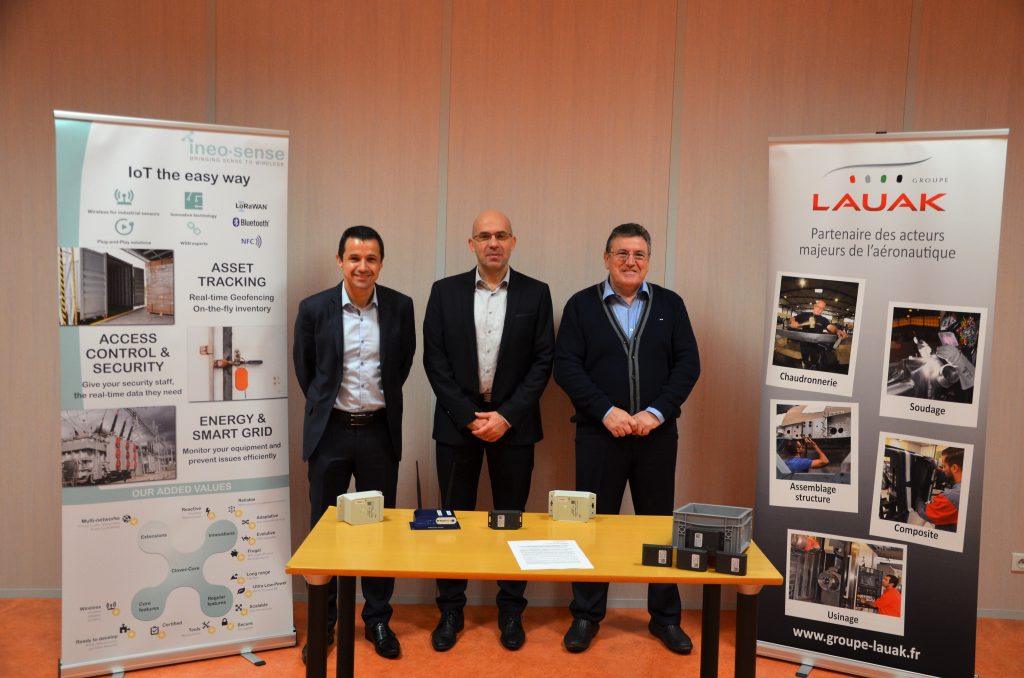
The Lauak Group optimizes aerospace production with a wireless IoT solution that locates manufacturing orders in real time across multiple industrial sites. This technology enables prioritization of workflows, reduction of transit times between operations, and significant improvement in meeting delivery deadlines.
In a world where efficiency and connectivity are paramount, LoRa technology stands out as a revolution in industrial IoT. Discover how this low-power, long-range technology is redefining IoT device communication by delivering innovative and eco-efficient solutions to industries.
The rapid evolution of monitoring technologies has transformed the way companies manage their assets. Smart sensors play a crucial role in this revolution, offering innovative solutions to optimize asset management and improve operational efficiency.
The Internet of Things (IoT) has become an essential lever for companies seeking to optimize their operations and drive growth. By integrating custom IoT solutions, industries can transform their processes, enhance efficiency, and unlock new market opportunities.