The pressure on delivery deadlines and the constant drive for productivity gains have made order picking one of the most critical links in the Supply Chain. In warehouses and on production lines alike, every second spent locating an item or moving unnecessarily between two locations translates into additional cost and longer lead times.
Pick-to-Light and Put-to-Light systems (respectively the light signal for picking and for putting) have become essential tools for streamlining these operations.
Yet their traditional installation, often wired and energy-intensive, hampers their deployment in modular, temporary or constrained environments.
This is precisely the barrier that Ineo Sense removes with its wireless solutions.
Streamline order picking and kitting with no cabling constraints
In a logistics warehouse or on a kitting production line, the speed and reliability of operators depends directly on the clarity of the instructions they receive.
A clear, immediate light signal positioned at the right location eliminates hesitation, reduces picking errors and accelerates throughput, without changing working habits or requiring lengthy training.
But deploying these systems on existing racking, in older buildings or on workstations that change regularly involves constraints that wired solutions simply cannot absorb.
The question is no longer whether Pick-to-Light delivers value (that's proven) but how to deploy it without civil works, without rigidity and without dependency on a permanent wired infrastructure.
Running cables along every rack bay involves heavy work, particularly in older warehouses, metal structures or areas with difficult access.
This installation cost can represent a significant share of the total project budget, sometimes to the point of making it hard to justify for mid-sized configurations.
Infrastructure rigidity
A wired system locks down the organisation of the warehouse or production line.
The slightest rack reorganisation, the addition of a new aisle or a change in product references requires recabling and reconfiguring the entire system, with all the delays and costs that entails.
For environments that evolve regularly, this rigidity is a real operational constraint.
Energy consumption and battery life
Traditional light indicators require a permanent power supply.
On mobile picking stations or in areas without accessible power outlets, this energy constraint directly compromises the feasibility of the project.
Responsiveness and readability in real conditions
Operators need to receive a clear, immediate and visible signal : even in noisy, poorly lit or high-throughput environments.
A system that responds with a noticeable delay, or whose indicators lack visibility, generates hesitation and errors that cancel out a significant part of the expected gains.
Ineo‑Sense's answer : wireless TRK and Report LED ranges
We have designed two ranges of 100% wireless Pick-to-Light and Put-to-Light indicators, built on our Clover-Core® architecture and communicating via a proprietary bidirectional LPWAN protocol.
They share the same fundamentals (no cabling, long battery life, sub-second responsiveness) but address distinct operational needs.
The TRK range for operator guidance in warehouses and on production lines
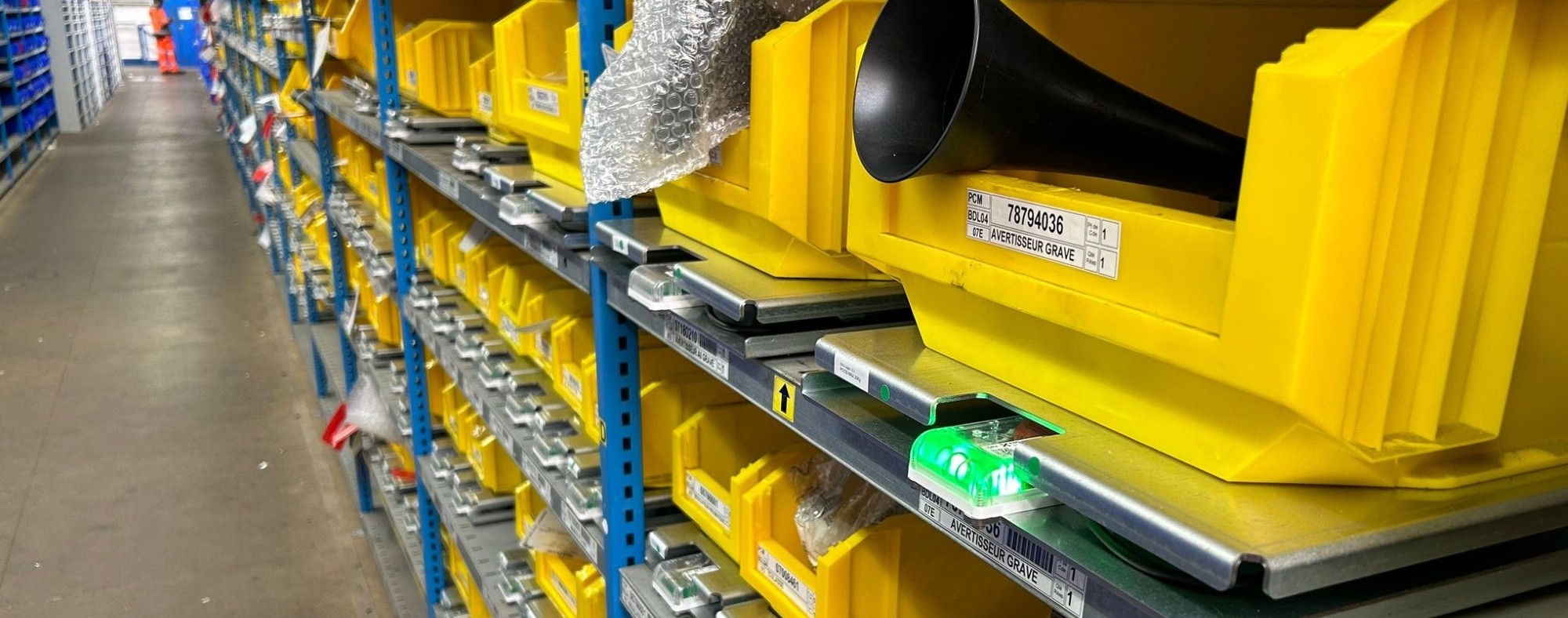
The TRK range of IoT sensors are designed to guide operators during high-throughput picking and putting operations.
They install directly onto racking, bins or workstations using magnetic fixings or clips : no tools, no cables, no electrical work required. Rack reorganisation takes a matter of minutes.
Their high-brightness RGB LED is visible even in poorly lit or high-activity environments.
The on/off command is sent via LoRaWAN or Clover-Net® message, with native integration into your existing WMS or picking application via REST API and MQTT.
The REP-Report-LED® IoT sensor for autonomous visual signalling in logistics and industrial environments
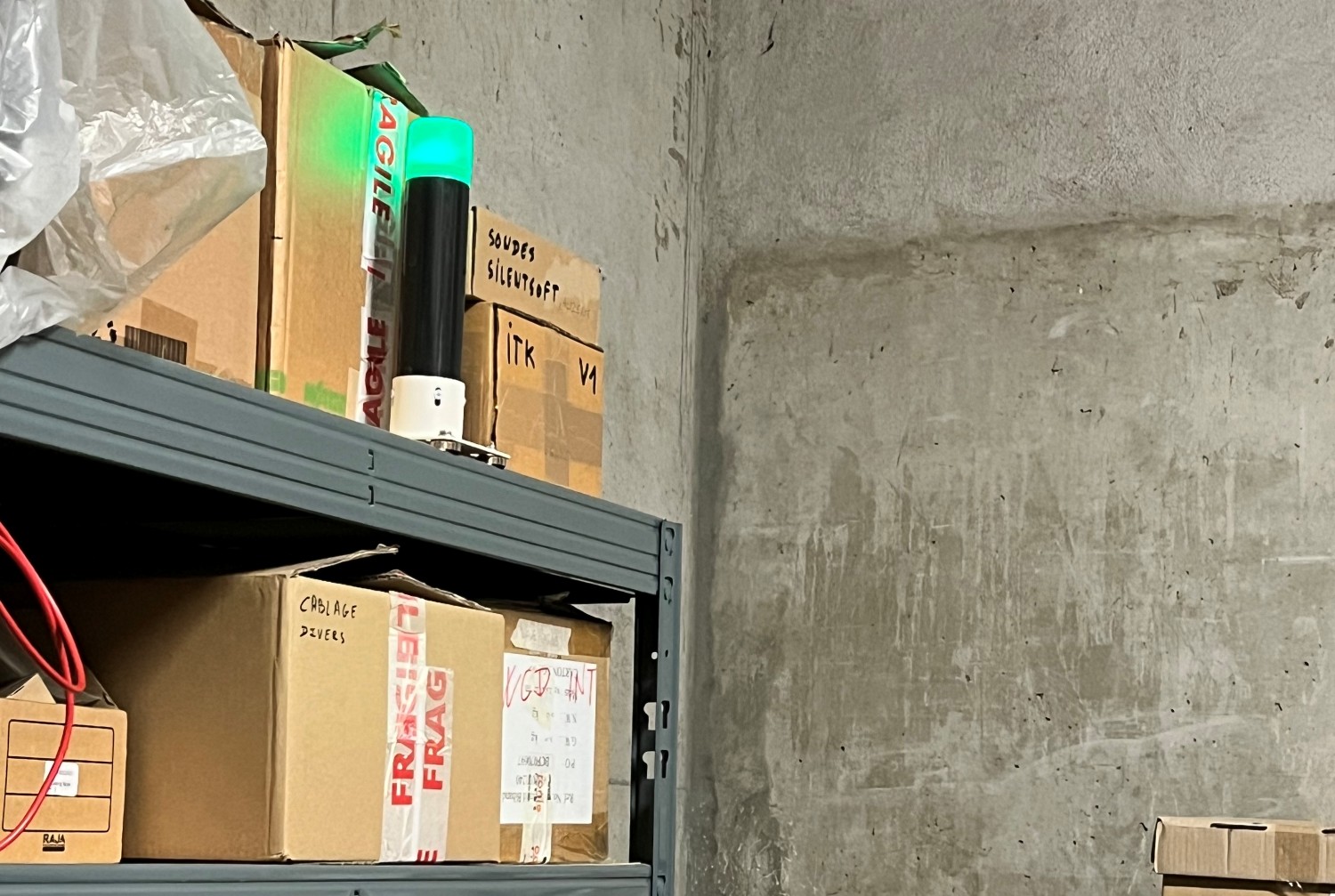
The REP-Report-LED® IoT sensor is an autonomous light indicator communicating via LPWAN network, with a battery life exceeding 5 years.
It is designed for applications where signalling must be persistent, reliable and independent of any external power supply: restricted-access zones, isolated workstations, warehouses without wired network infrastructure.
It features an optional buzzer (REP-Report-LED + ACS-Switch-BUZZ version) to reinforce notification in noisy environments, timestamped activation datalogging, and remote parameter management via OTA (illumination duration, LED intensity, data transmission frequency) with no physical on-site intervention required.
Shared characteristics across both ranges
Both ranges share IP54-certified industrial robustness (dust and splash resistance) suited to logistics and production environments.
They both offer embedded statistics: activation counting, timestamped logging and periodic data uploads to optimise picking ratios and size teams accordingly.
And they both benefit from Clover-Core® multi-network modularity (LoRaWAN, Clover-Net or WiFi depending on your infrastructure) with no reconfiguration of your IS.
Operational Benefits
Productivity gain
Up to 30% reduction in travel time and picking errors.
Flexibility
Instant adaptation of picking zones without any cabling work.
Quick return on investment
Savings on cable installation, labor, and maintenance combined with increased picking throughput.
Visually guided operators, reducing cognitive fatigue and stress from incorrect instructions.
Analytical data
Activity indicators usable to size workforce, optimize layouts, and anticipate bottlenecks.
Use cases
Mixed Manufacturing Assembly
An operator switches from one production line to another; the system lights up only the LEDs corresponding to their reference, reducing errors and speeding up the pace.
E-commerce Order Picking
In a high-turnover warehouse, mobile teams receive storage or picking locations via a tablet; the wireless displays guide them instantly.
Temporary Storage
For seasonal storage or a temporary warehouse, the cable-free deployment saves significant time and budget.
Restricted Access Areas
In a sensitive workshop, you can remotely control the indicators without opening the door, limiting contamination and disruptions.
Business sectors
The industry sectors we regularly address for these challenges
What is the difference between Pick-to-Light and Put-to-Light ?
Pick-to-Light guides the operator during item picking: a light indicator activates at the relevant location to show what to take and in what quantity. Put-to-Light works on the same principle but for putting : it indicates where to place the picked item, typically during sorting or kitting operations. Both can operate in combination on the same line or workstation.
Are wireless systems as reliable as wired systems ?
Yes, provided the solution is designed for a real industrial or logistics environment. Our IoT sensors are built on a robust architecture, tested in warehouse and production conditions, and communicate over low-latency radio protocols. Responsiveness is under one second, comparable to traditional wired systems.
How long does the battery last in the sensors ?
Our sensors have a battery life of several years under normal use. The exact duration depends on usage frequency and network configuration, but it is systematically assessed and documented during the design phase. Battery replacement is straightforward and does not require specialist technical intervention.
Do these systems integrate with our existing WMS ?
Yes. Our solutions offer standard API interfaces compatible with the leading WMS platforms on the market. If your system uses a specific protocol, our integration service can handle the adaptation.
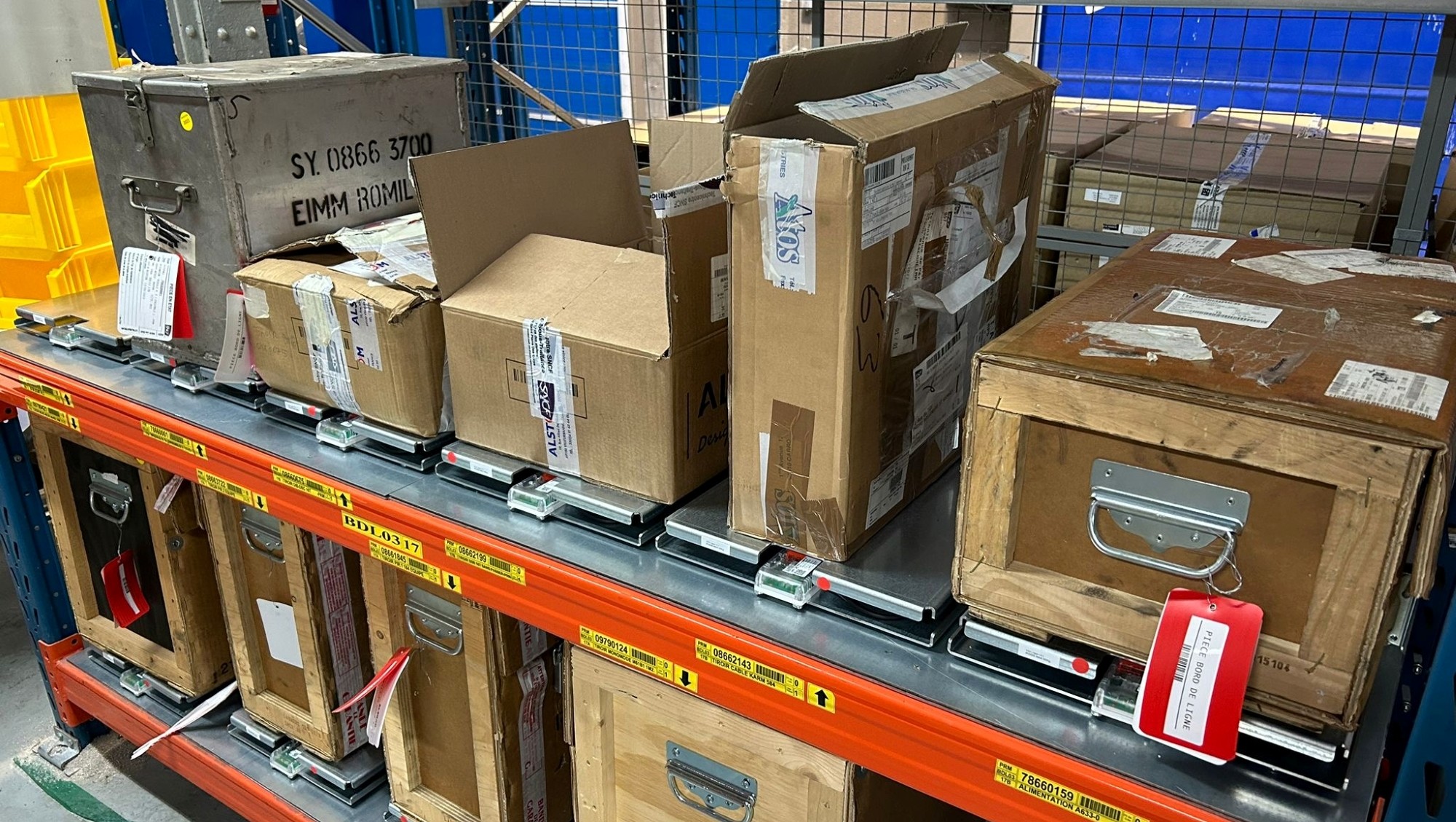
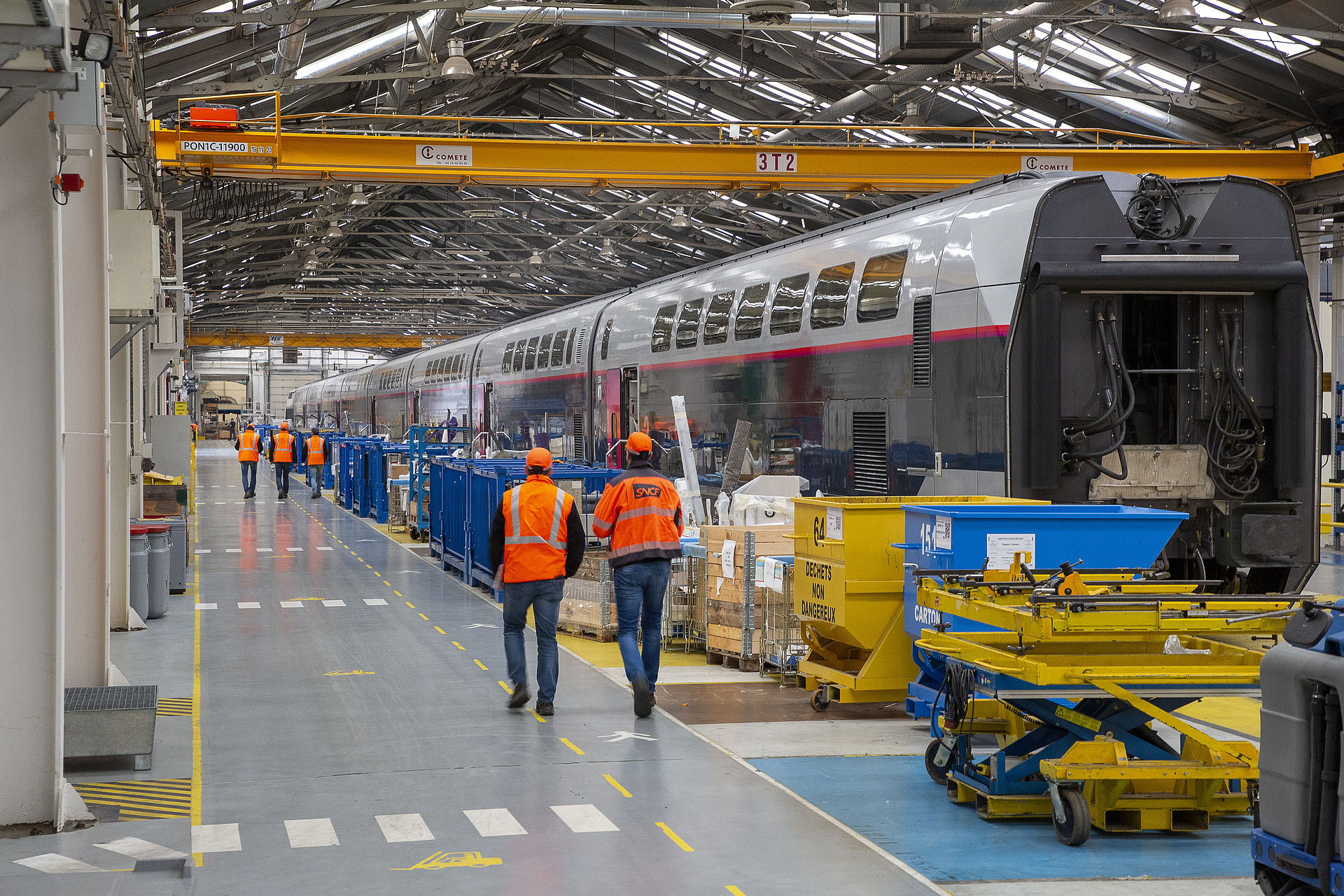
At the heart of SNCF technicentres, spare parts management becomes smart thanks to connected scales. By eliminating discrepancies between physical and theoretical stock, maintenance operations become more responsive, shortages are anticipated, and trainset availability is secured.
In a world where efficiency and connectivity are paramount, LoRa technology stands out as a revolution in industrial IoT. Discover how this low-power, long-range technology is redefining IoT device communication by delivering innovative and eco-efficient solutions to industries.
The rapid evolution of monitoring technologies has transformed the way companies manage their assets. Smart sensors play a crucial role in this revolution, offering innovative solutions to optimize asset management and improve operational efficiency.
The Internet of Things (IoT) has become an essential lever for companies seeking to optimize their operations and drive growth. By integrating custom IoT solutions, industries can transform their processes, enhance efficiency, and unlock new market opportunities.