#SmartCity
12 June 2026
Parking space sensor : how occupancy detection works
In a car park in operation, a driver spends several minutes on average looking for a free space.
This wasted time clogs the traffic lanes, degrades the user experience and projects an ageing image of the service. For the operator, the problem goes beyond momentary inconvenience, because a poorly managed structure handles fewer rotations, generates less revenue and consumes more energy.
At the heart of the answer to these challenges lies a discreet but decisive component : the parking space sensor.
It detects the occupancy of each space and feeds the entire guidance system. We explain here how it works, which technologies it relies on and which criteria truly matter when you equip a structure.
Why equip every space with an occupancy sensor
A car park can only be managed well if you know, at every moment, the real status of its spaces.
Without occupancy data, the operator navigates blind : they do not know which zones fill up first, they cannot spot the vehicles that tie up a space for hours, and they cannot direct drivers toward the spaces still available.
The parking space sensor solves precisely this gap. Installed on each space, it detects the presence or absence of a vehicle and transmits this information continuously.
This data serves several uses that reinforce one another. It first enables space-by-space guidance, since the system knows which spaces to signal as free.
It then feeds operational management, because aggregating the status of each space produces a reliable occupancy rate, zone by zone and level by level.
Finally, it supports the relationship with the user, once the data flows to display panels or a mobile app.
A smart parking sensor does not simply say "occupied" or "free", it becomes the base building block of a genuinely connected car park.
Occupancy detection technologies
Not all parking space sensors detect in the same way.
Three main families of technology coexist on the market, each with its strengths and limits. Understanding these differences helps you choose the solution suited to the layout of your structure.
Infrared detection with a PIR sensor
Infrared detection relies on variations in thermal radiation within the sensor's field. When a vehicle enters the space, it alters the infrared signature captured, which triggers presence detection. This technology offers very low consumption and great simplicity of installation.
It suits covered, stable environments particularly well, where parasitic thermal variations remain limited. Our ACS-Switch-PIR® sensors use this principle to confirm a vehicle's presence in an energy-efficient way.
Distance measurement by time-of-flight
Time-of-flight measurement, or ToF technology, works on a different principle.
The sensor emits a signal toward the floor and measures the time this signal takes to return. When a vehicle occupies the space, the measured distance drops sharply, which indicates occupancy. This approach proves precise and largely insensitive to thermal disturbances, which makes it reliable even in areas where infrared alone reaches its limits.
Our ACS-Switch-TOF® sensors rely on this distance measurement and effectively complement infrared detection. By combining both technologies on the same site, we make detection reliable whatever the layout of the spaces.
Magnetic detection
Magnetic detection forms the third family commonly used in parking.
The sensor measures the variations in the earth's magnetic field caused by the metallic mass of a vehicle. This technology detects a vehicle's presence robustly, including outdoors. However, it often requires flush mounting in the ground, which adds to the installation and complicates maintenance.
For a structure in operation, this works constraint weighs heavily in the trade-off, and it explains why many operators turn to surface-mounted solutions that are faster to deploy.
Wired or wireless : the choice that shapes your installation
Beyond the detection technology, the sensor's communication mode determines the very nature of your project.
It is a criterion that operators sometimes underestimate, even though it governs the cost, the duration and the flexibility of the installation.
The limits of the wired sensor
A wired parking space sensor requires pulling a cable to each space.
In an existing structure, this means drilling trunking, dismantling suspended ceilings and coordinating works that interrupt operations.
The cabling cost frequently exceeds that of the sensors themselves, and the slightest change to the traffic plan forces you to rework the physical network.
This rigidity makes wired solutions poorly suited to structures that evolve or that seek to limit the duration of works.
The contribution of wireless and LoRaWAN
The wireless sensor removes this cabling constraint. It runs on battery and transmits its data by radio, which allows it to be fixed with screws or adhesive, then commissioned from a smartphone.
Long-range radio technologies such as LoRaWAN and Clover-Net® pass through concrete structures and cover several levels from a small number of gateways.
You can therefore equip an entire structure without drilling a single load-bearing wall, and you add or move a sensor without ever stopping operations. We explain how this radio network is deployed in an underground car park in a dedicated article.
This flexibility explains why wireless is gradually establishing itself in underground and covered car parks, where wired works prove the heaviest.
The criteria for choosing a parking space sensor
Once the technology and the communication mode are understood, several concrete criteria guide your decision.
Battery life comes first, because a sensor that lasts several years on battery greatly reduces maintenance and secures your operating budget.
The mounting method matters just as much, since surface fixing avoids the civil engineering works that flush-mounted sensors impose.
Robustness determines the real lifespan of the fleet, and a sensor operating from -20°C to +60°C withstands the demanding environments of outdoor and underground car parks alike.
The reliability of detection deserves particular attention. A sensor that combines two technologies, for example infrared and time-of-flight, limits false positives and missed detections, which guarantees accurate information for drivers.
Finally, integration capability makes the difference over the long term. A sensor that exposes its data through an open API feeds your display panels, your supervision and your existing applications, whereas a closed system locks you into a single ecosystem.
Taken together, these criteria separate a simple detector from a genuine smart parking sensor.
From sensor to guidance : integrating detection into a complete solution
A parking space sensor only delivers its full value when it fits into a complete solution. Occupancy detection is the first building block, but it calls for clear signaling for the user and actionable management for the operator.
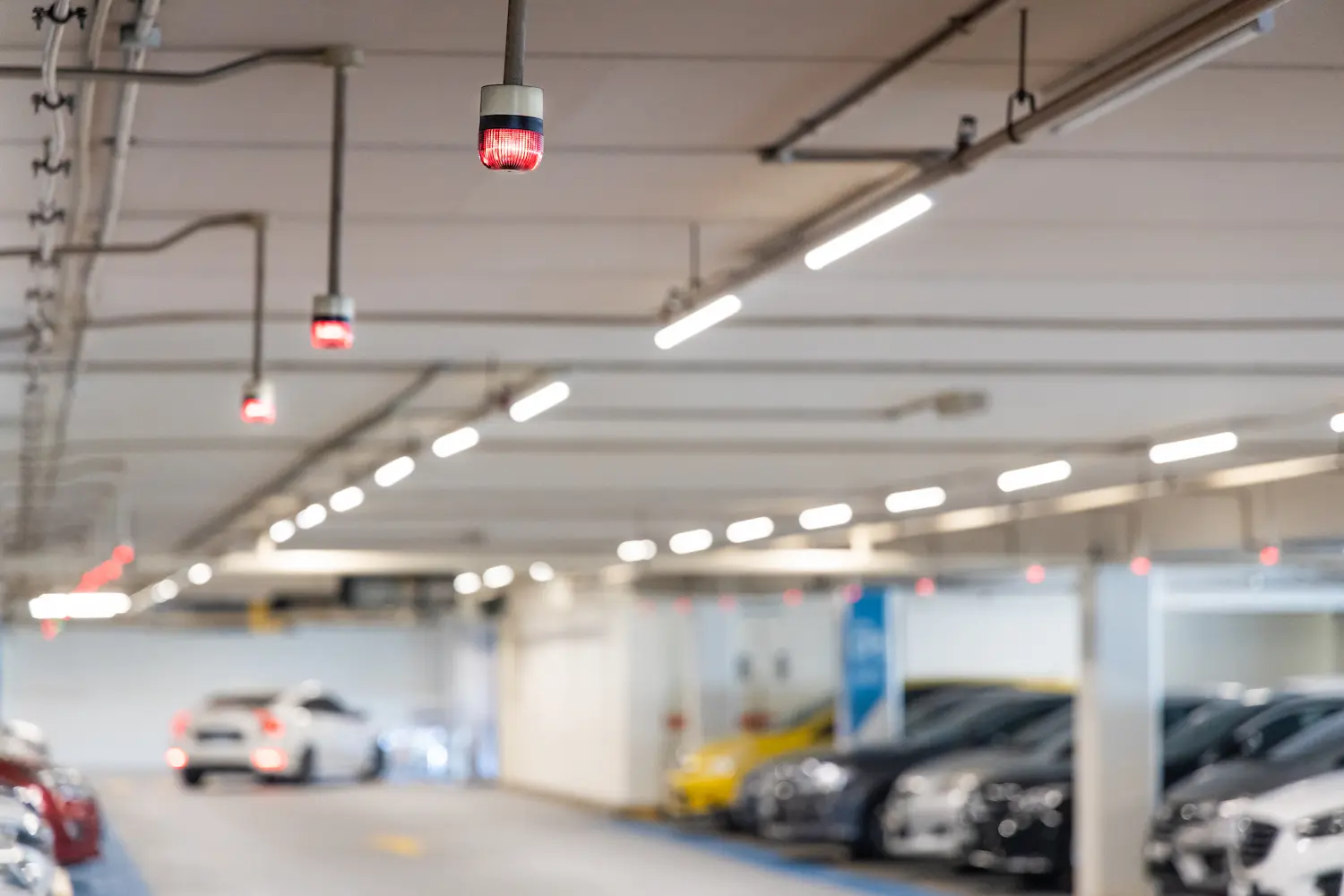
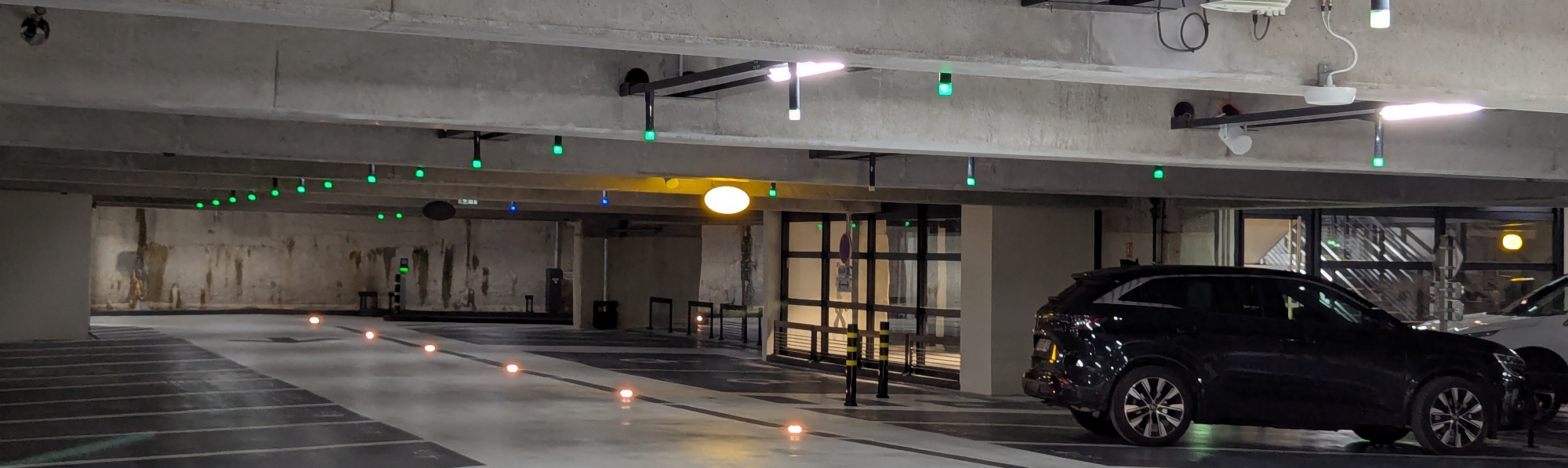
This is the logic we adopted for our wireless space-by-space guidance solution GalaP.SYS®, which combines our detection sensors with a light indicator above each space and real-time data reporting.
The driver spots a free space at a glance, while the operator tracks the occupancy rate and anticipates peak periods. This logic is part of a broader smart parking approach, which we cover here.
The parking space sensor therefore sits at the starting point of a value chain that runs from detection to the overall management of the car park.
By choosing a reliable technology, a works-free mounting method and open integration capability, you lay the foundations of a genuinely fluid and connected car park.
Would you like to assess the solution suited to your structure ?
Our teams study your configuration and support you in choosing the sensors.
Contact us to discuss your project.