#SmartCity
24 June 2026
Deploying a radio network in an underground car park
Fitting an underground car park with wireless sensors runs into a recurring technical objection : will the radio signal really pass through an environment made of concrete, ramps and stacked levels ?
The question is legitimate, because a poorly sized network leaves blind spots and undermines the whole guidance service. Yet it is precisely in these difficult structures that wireless delivers the most value, by avoiding heavy and costly cabling works.
We explain here why LoRaWAN suits underground car parks, how it passes through concrete structures and how to size the coverage to equip a multi-level car park reliably.
The challenge of radio coverage in an underground environment
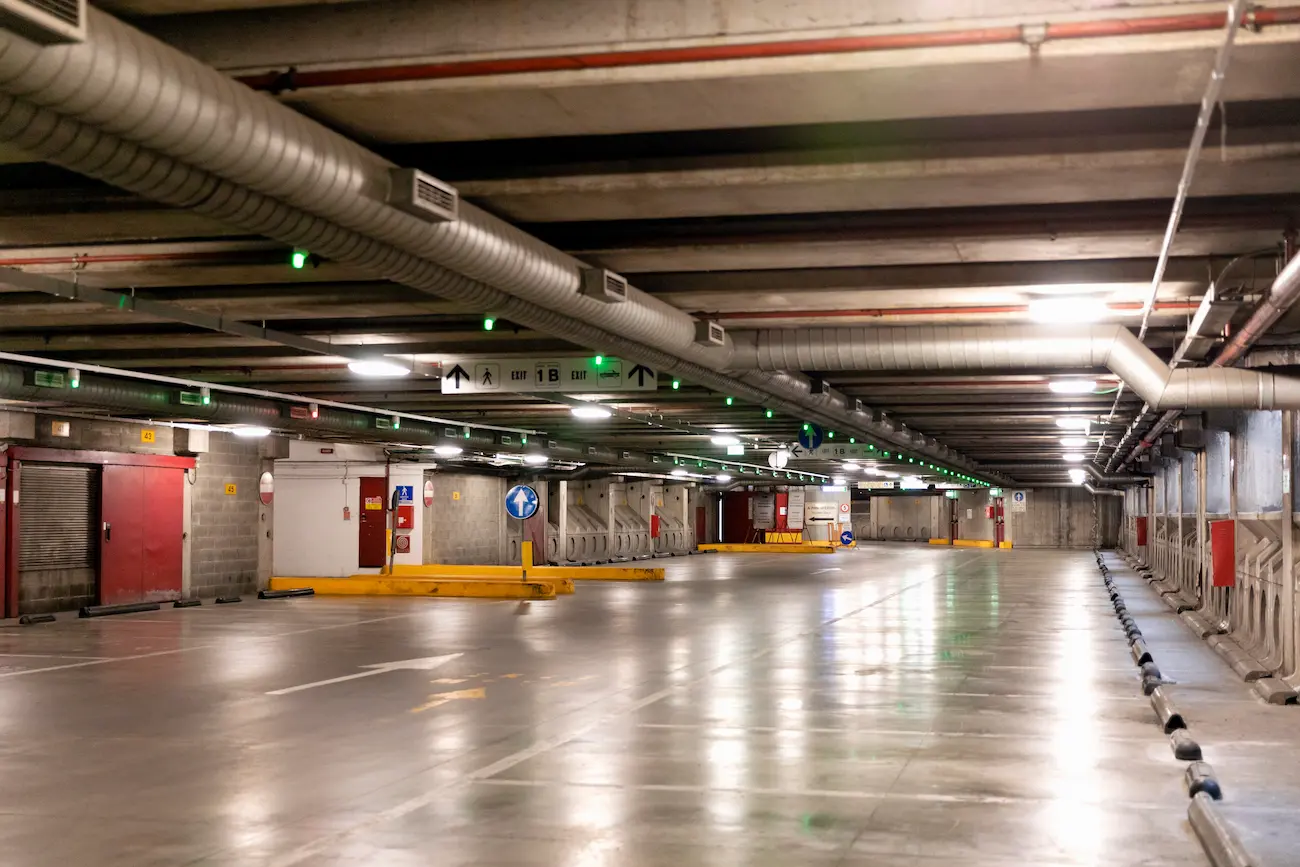
An underground car park concentrates several constraints that make radio propagation tricky.
Reinforced concrete slabs absorb part of the signal, load-bearing walls partition the space, and multiple levels stack the obstacles between a sensor and its gateway.
Add to this the ramps, stairwells and technical ducts, which locally alter propagation. A driver moves from one level to another without a thought, but for a radio signal, each slab crossed represents additional attenuation.
These constraints explain the difficult reputation of underground spaces for wireless technologies. They also explain why cabling is particularly heavy there: running a wired network to every space means drilling, fixing trunking and interrupting operations, in an environment where every intervention is expensive.
This is what makes wireless attractive, provided you choose a radio technology suited to penetration and size the coverage correctly. LoRaWAN answers precisely this set of requirements.
Why LoRaWAN suits underground car parks
Not all radio technologies perform equally in a constrained environment.
LoRaWAN rests on a particular trade-off between range, penetration and consumption, which makes it suited to occupancy detection in underground car parks.
Range and penetration through concrete
LoRaWAN uses a spread-spectrum modulation that favors the robustness of the link rather than throughput.
In practice, the signal withstands attenuation and obstacles better than a conventional high-throughput transmission.
This characteristic allows it to pass through concrete structures and cover several levels where other technologies drop out.
The high link budget, meaning the margin between the transmitted power and the reception threshold, offers a valuable reserve to offset the losses specific to underground spaces.
We complement this coverage with Clover-Net®, our radio technology, to strengthen service in the most difficult areas of a structure.
A modest throughput, but suited to occupancy data
The counterpart to this robustness is a low throughput. This limit is not one for our use, because occupancy data comes down to a simple piece of information : the space is free or occupied.
This message weighs very little and does not need to be transmitted continuously, but only when the status of the space changes.
LoRaWAN therefore carries this type of data without difficulty, where it would be unsuited to video or a high-volume stream.
The technology is thus sized exactly to the real need of space-by-space guidance.
Low consumption and multi-year autonomy
LoRaWAN was designed for devices that run on battery for years.
Its low consumption allows sensors to last several seasons without intervention, which radically changes the economics of a car park deployment.
Where a wired network requires a power supply at every point, LoRaWAN sensors rely on their internal battery, with no cable or electrical connection.
This autonomy reduces maintenance and secures the operating budget over time, a decisive argument for a car park with several hundred spaces.
Sizing the coverage : gateways and architecture
A LoRaWAN network relies on gateways, which collect the sensors' messages and relay them to the platform.
The whole deployment logic consists of positioning these gateways so as to cover the entire car park with the most appropriate number.
Thanks to the range of LoRaWAN, a small number of gateways is generally enough to serve an entire structure, including across several levels.
Placement matters more than quantity. A well-positioned gateway, in a central and unobstructed spot, covers more effectively than a multiplication of poorly distributed gateways.
In a multi-level car park, the aim is to ensure that no zone remains out of range, taking into account the slabs and partitions.
Depending on the configuration, an architecture can include redundancy, so that a given zone is seen by several gateways and the loss of one device does not create a blind spot.
This sizing is worked out case by case, according to the geometry of the structure.
The points to watch for a successful deployment
A radio deployment underground needs preparation.
The first point to watch is the prior coverage study. Before installing anything, a site survey makes it possible to identify the risk areas, test real propagation and validate the number and location of the gateways.
This step avoids unpleasant surprises and makes the project reliable, because no theoretical plan replaces a measurement on site.
The positioning of the sensors deserves the same attention.
Placed on the ceiling or the floor depending on the configuration, they must keep a stable link with at least one gateway. End-to-end tests, once the installation is complete, confirm that each space properly reports its status and that no zone is left out.
Finally, it is worth accounting for any sources of interference and the coexistence with other radio equipment present in the structure.
These precautions, taken upstream, make the difference between a reliable network and an approximate deployment.
From coverage to service : reporting the data
Once the radio network is in place, coverage is no longer an end in itself but a means.
The sensors report the status of each space to the platform, which turns these signals into a concrete service.
It is this data that feeds the light guidance above the spaces, the calculation of the occupancy rate and the real-time availability of spaces.
It then flows toward the display panels, the supervision and the applications aimed at users, through an open API.
The radio deployment is therefore the invisible foundation on which everything else rests. Without reliable coverage, no guidance or management is possible; with it, an underground car park becomes a fluid, connected service.
This is the architecture we implement in our wireless space-by-space guidance solution GalaP.SYS®, which combines detection, signaling and data reporting without any cabling.
To understand the role of the sensor upstream of the network, we detail how it works in our article on the parking space sensor, and we place the whole picture in an operational context in our article on smart parking.
Frequently asked questions about radio deployment in car parks
Does LoRaWAN really pass through the concrete of an underground car park ?
Yes, to a large extent. LoRaWAN modulation favors the robustness of the link rather than throughput, which allows it to withstand attenuation and pass through concrete structures across several levels. A prior coverage study is nevertheless recommended to validate propagation in each configuration.
How many gateways are needed to cover a car park ?
It depends on the geometry of the structure, the number of levels and the partitions. Thanks to the range of LoRaWAN, a small number of gateways is generally enough to cover an entire car park. The precise sizing is determined from a site survey.
Is a prior study necessary before deployment ?
Yes. An on-site coverage survey makes it possible to identify difficult areas, test real propagation and position the gateways correctly. This step makes the deployment reliable and avoids blind spots.
Can the network be extended after the initial installation ?
Yes. The wireless architecture lends itself to extension. You can add sensors or gateways without redoing any cabling, which makes it possible to equip new zones or densify the coverage as needs arise.
Are you preparing to equip an underground car park and wondering about radio coverage ?
Our teams carry out the study of your structure and size the network to its configuration.
Contact us to discuss your project.