#SmartCity
12 January 2026
Remote water meter reading: how to monitor consumption from a distance
Water management has become a major challenge for local authorities, building managers and industrial operators. Monitoring water consumption accurately not only helps optimize usage, but also enables the early detection of anomalies such as leaks or abnormal consumption.
For a long time, water meter readings relied mainly on manual on-site interventions. Although this method is still widely used, it has several limitations: low reading frequency, risk of human error and difficulty detecting problems quickly.
Remote water meter reading now makes it possible to collect consumption data automatically and monitor water usage remotely using connected sensors and communication technologies.
What is remote water meter reading?
Remote meter reading refers to the automatic collection of data from a water meter and its transmission to a remote monitoring platform.
Unlike manual readings, data can be transmitted regularly to a platform that allows operators to visualize consumption and analyze trends over time.
Remote reading systems can be used to:
- monitor water consumption in real time
- analyze historical consumption data
- detect anomalies
- improve water management across multiple sites.
This technology is now widely used in smart city projects, building energy management and industrial infrastructure monitoring.
Why automate water meter readings?
Remote water meter reading offers several advantages compared to traditional manual methods.
Better visibility on water consumption
With an automated system, data can be collected several times per day, or even in near real time.
This higher frequency provides a much more accurate view of water usage.
Faster leak detection
Continuous data analysis helps detect anomalies such as:
- unusual night-time consumption
- constant water flow
- sudden increases in consumption.
These signals may indicate a water leak or a network malfunction.
Easier multi-site infrastructure management
For organizations managing multiple buildings or facilities, remote reading allows operators to centralize consumption data on a single monitoring platform.
This makes it easier to track performance and compare consumption between different sites.
How remote water meter reading works
Remote reading systems generally rely on three main components.
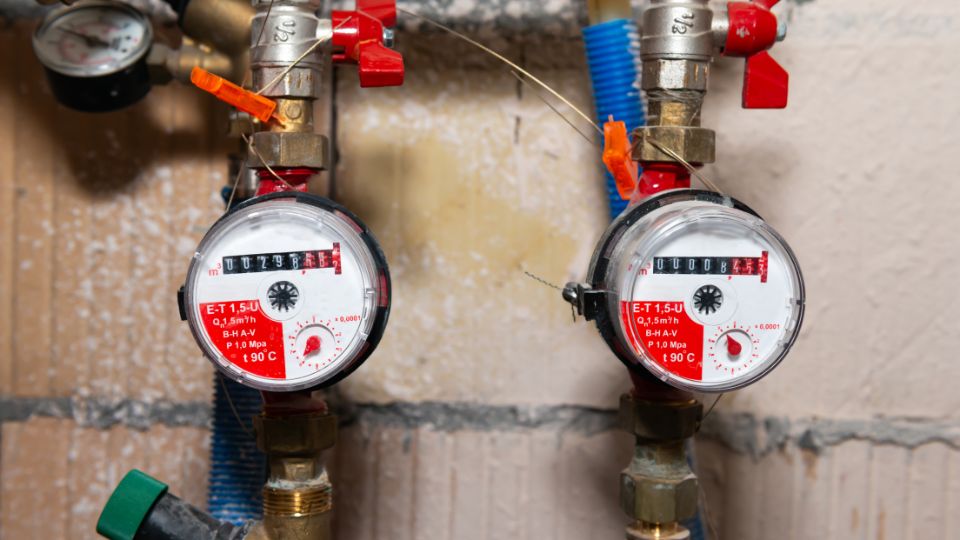
The water meter
The water meter measures the volume of water consumed.
Many meters are equipped with a pulse output, which generates an electrical pulse for each unit of water consumption.
The data collection sensor
A connected sensor can be installed on the meter to record pulses and convert them into digital data.
These sensors can operate on battery power for several years.
The communication network
The collected data is transmitted to a monitoring platform using communication networks.
Common technologies include:
- LoRaWAN
- NB-IoT
- LTE-M.
These networks allow data to be transmitted over long distances while consuming very little energy.
Remote reading and existing water meters
In many cases, it is not necessary to replace existing water meters in order to deploy a remote reading system.
Meters equipped with a pulse output can be connected to an IoT sensor capable of collecting pulses and transmitting the data remotely.
This approach makes it possible to modernize existing infrastructure without heavy installation work or equipment replacement.
Use cases for remote water meter reading
Remote meter reading is now widely used in many contexts.
Water management in buildings
Building managers can monitor water consumption:
- per building
- per zone
- per usage.
Urban infrastructure monitoring
Local authorities can use remote reading to improve:
- water network management
- leak detection
- resource optimization.
Industrial water consumption monitoring
In industrial environments, remote meter reading helps operators better control water usage within production processes.
Remote meter reading with IoT sensors
IoT technologies have significantly simplified the deployment of remote meter reading solutions.
IoT sensors now make it possible to:
- connect existing meters
- transmit data automatically
- centralize information on a monitoring platform.
This approach improves water consumption management and infrastructure efficiency.
Going further: connecting existing water meters
Remote meter reading is a key step toward improving water management and optimizing consumption.
In many cases, it is possible to connect existing meters without replacing the equipment, especially by using sensors capable of collecting pulses generated by water meters.