#SmartCity
18 June 2026
Smart parking : cut search time and smooth traffic in your car park
Searching for a space in a saturated car park creates frustration for the user and a loss of value for the operator.
Lanes clog up, rotations slow down and the image of the service suffers, even though the structure often has free spaces that are simply impossible to find.
Smart parking answers this paradox directly. By equipping a car park with sensors, signaling and management tools, it makes visible in real time what used to remain invisible : the exact status of every space.
We explain here what smart parking is, which building blocks it relies on and which concrete benefits it delivers, from the comfort of the driver to the revenue of the operator.
What is smart parking
Smart parking is a car park where every space reports its occupancy status continuously, in order to guide drivers and manage operations from real data.
It is not simply an additional piece of equipment, but a change of logic. Where a conventional car park operates blind, a smart car park knows at every moment the number and location of its available spaces, and it shares this information with the user and the manager alike.
This intelligence rests on a coherent chain. Detection identifies the occupancy of each space, signaling directs the driver, and data reporting feeds the supervision and the services aimed at the user.
Intelligent parking therefore does not come down to a single isolated technology, it emerges from the combination of several building blocks that turn a passive car park into an active, responsive service.
The building blocks of smart parking
Smart parking combines several components that complement one another.
Each plays a precise role, and it is their combination that produces the final value.
Occupancy detection
Everything starts with knowing the real status of the spaces.
Sensors installed on each space detect the presence or absence of a vehicle and transmit this information continuously.
This is the founding block, the one without which no other works, since it produces the data that the whole system then relies on. We explain how the parking space sensor works and its detection technologies in a dedicated article.
The reliability of this detection directly governs the quality of the guidance and the accuracy of the operational indicators.
Light guidance
Detection only serves the user if it translates into readable information on the ground.
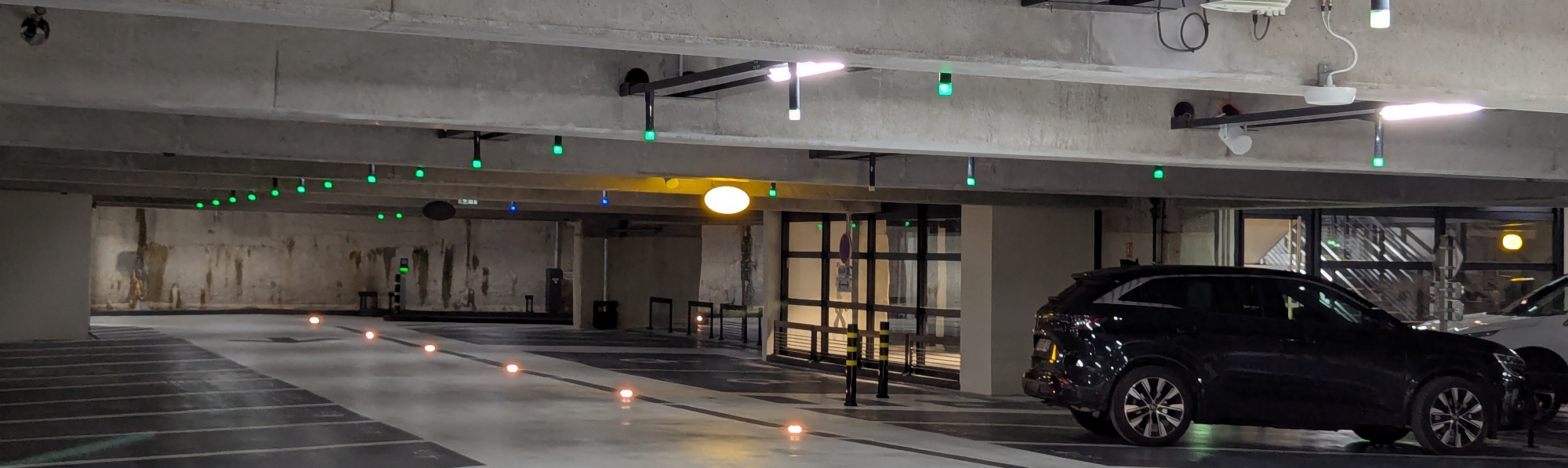
A light indicator placed above each space shows a color according to its availability, usually green for a free space and red for an occupied one.
The driver then spots an available space as soon as they enter the aisle, without hesitation and without taking their eyes off the lane.
This space-by-space guidance is the most visible expression of smart parking, the one the user notices immediately.
Data and user services
Beyond on-site guidance, occupancy data feeds a layer of services.
Display panels at the entrance announce the number of free spaces per level or per zone, while a mobile app can direct the driver even before arrival.
This layer turns the parking experience into an anticipated journey rather than a hit-or-miss search, and it extends the intelligence of the car park all the way to the user's smartphone.
The benefits of smart parking
The value of smart parking is measured through concrete effects that touch both the user and the operator.
These benefits reinforce one another and justify the investment over time.
Reducing search time and smoothing traffic
The most immediate benefit concerns the time spent searching for a space. By directing the driver straight to a free space, guidance sharply reduces the minutes spent circling, with gains reaching 30 to 50% depending on the configuration.
This reduction smooths circulation inside the structure, limits congestion points at peak times and lowers user stress.
A more fluid car park also handles more rotations, which directly benefits its operation.
Optimizing revenue and operations
Smart parking improves the economic performance of the car park.
A better spread of occupancy makes it possible to value spaces that were previously underused, without extending the structure. Tracking the occupancy rate helps the operator adjust pricing and anticipate peak periods.
Detecting vehicles that tie up a space beyond reason also frees up capacity, and therefore potential revenue.
Data thus becomes a management lever, not merely a guidance tool.
Strengthening image and environmental commitment
A fluid, modern car park enhances the image of its operator, whether a local authority, a shopping center or a private manager. The user associates the service with a well-managed experience, which reinforces loyalty.
The benefit is also environmental, because a vehicle that quickly finds its space circles less, consumes less fuel and emits less CO₂.
Smart parking therefore supports a tangible environmental approach, based on measurable effects rather than intentions.
From guidance to data : managing the car park in real time
The real breakthrough of smart parking lies in the shift from guidance to management.
Guiding a driver toward a free space is the visible benefit, but running a modern car park rests on a continuous reading of the data.
By aggregating the status of every space, the manager obtains a precise occupancy rate, zone by zone and level by level, updated at all times.
This fine-grained view makes it possible to identify the zones that saturate first, to spot anomalies and to adjust the organization of the car park accordingly.
This data only has value if it flows toward the right tools.
An open solution, equipped with an API, feeds the display panels, the technical supervision and the applications aimed at users, and it integrates with the existing ticketing system. The operator thus avoids being locked into a closed ecosystem and keeps control of its data.
Intelligent parking then becomes a genuine information system serving the car park, able to evolve with its needs.
Setting up smart parking without heavy works
One of the historical barriers to intelligent parking lay in the scale of the works needed to equip an existing car park.
Cabling each space meant drilling, dismantling suspended ceilings and interrupting operations for weeks. Wireless solutions have removed this obstacle.
By relying on autonomous sensors that communicate over long-range radio, they make it possible to equip an entire structure without cabling, with surface mounting and rapid commissioning. This radio deployment in an underground car park relies on long-range technologies that we detail in a dedicated article.
This is the approach we adopted for our wireless space-by-space guidance solution GalaP.SYS®, which combines occupancy detection, light signaling and real-time data reporting.
It makes a car park smart without civil engineering works, with reduced maintenance and several years of autonomy.
We have deployed this solution in urban car parks in operation, and we detail the results obtained in our case study on urban parking guidance with LPA.
Smart parking is therefore no longer reserved for new builds. Any operator can turn an existing car park into a fluid service, driven by data and mindful of the environment.
Would you like to assess the benefits of smart parking for your structure ?
Our teams study your configuration and size the solution to your constraints.
Contact us to discuss your project.